| Startseite | zurück | Wissenschaftliche Untersuchungsergebnisse | Fortsetzung |
Ist TM-Forschung unabhängig?Wissenschaftliche Untersuchungen werden nach bestimmten Standards durchgeführt, die erfüllt sein müssen, damit die Veröffentlichung zugelassen wird. Dabei spielt es keine Rolle, ob der Wissenschaftler meditiert oder nicht, ebenso wenig wie die Religionszugehörigkeit oder die politische Überzeugung. Die Motivation für die TM-Forschung
liegt im objektiven Nachweis von subjektiven
Erfahrungen. Diese Motivation hat normalerweise nur
jemand, der gute subjektive Erfahrungen mit der TM
gemacht hat. Diese Forscher könnte man als "nicht
unabhängig" ansehen. |
Wenn
nun nicht-meditierende Forscher im Auftrag der
TM-Organisation forschen, dann sind sie ebenfalls nicht
(finanziell) unabhängig. Forschung der Maharishi
University of Management, die vom Staat gefördert wird,
ist natürlich auch nicht „unabhängig“.
Wie ist denn dann überhaupt
unabhängige Forschung möglich, zumal die persönliche
TM-Erfahrung wichtig für die Qualität der Forschung ist?
Aus diesem Grund wurden neuere Forschungsarbeiten in
Kooperation mit anderen Universitäten und
nicht-meditierenden Wissenschaftlern zum Teil mit
staatlicher Unterstützung durchgeführt. Unabhängiger
kann diese Art von Forschung nicht sein. Die
Forschungsergebnisse, die auf diese Weise gewonnen
wurden, unterscheiden sich allerdings nicht von
früheren. |
|
Markovsky
zufolge wird ein Großteil der Forschung zur
Transzendentalen
Meditation von den TM-Organisationen finanziert. Die
beteiligten
Wissenschaftler seien nicht neutral und versuchten
nicht, ihre
Theorien zu widerlegen (wie es der kritische
Rationalismus einfordern
würde), sondern sie zu belegen.“ [ff]
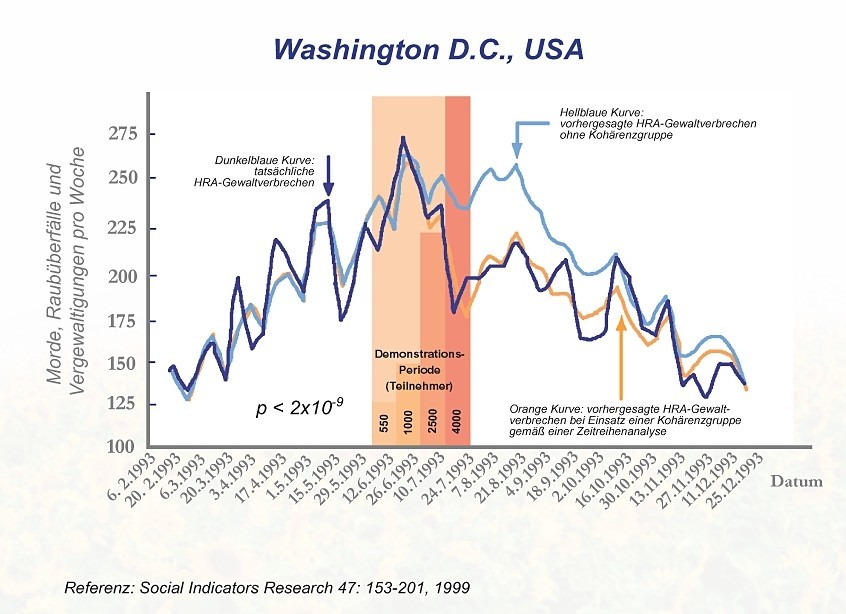
(https://de.wikipedia.org/wiki/Transzendentale_Meditation#Neutralit%C3%A4t) Das Problem: Haben Kritiker das internationale Friedensprojekt im Nahen Osten widerlegt? Die Beweise: Orme-Johnson DW, Oates RM. Eine feldtheoretische Sicht des Bewusstseins: Antwort an Kritiker. Journal of Scientific Exploration 2008 23(2):139-166. pdf des Artikels Zusammenfassung – Dieser Artikel antwortet auf eine Kritik (Fales & Markovsky, 1997) einer Studie, die berichtet, dass die Gruppenpraxis des Transzendentalen Meditationsprogramms einen messbaren Einfluss auf objektive Messungen der Lebensqualität in Israel und des Krieges im Libanon hatte (Orme-Johnson et al., 1988). Die Kritiker schlugen verschiedene kulturpolitische Ereignisse als alternative Erklärungen für die Ergebnisse vor. Diese Ereignisse konnten die Ergebnisse nicht erklären, wie (1) einfache Überprüfung der veröffentlichten Daten; (2) statistische Analysen, die diese Ereignisse kontrollieren; (3) Analysen von reduzierten Datensätzen, die die Tage der Ereignisse vollständig aus den Analysen eliminierten; und (4) Analysen von sechs Stichproben von 50% der Daten. Obwohl einige der vorgeschlagenen kulturellen/politischen Ereignisse einen signifikanten Einfluss auf einen zusammengesetzten Index von Kriminalität, Verkehrsunfällen, Bränden, Kriegsintensität, Aktienmarkt und nationaler Stimmung hatten, waren die Auswirkungen dieser Ereignisse unabhängig von der Wirkung der Meditierenden und konnten es nicht erklären. |
Wir argumentieren, dass
Maharishis Theorie des kollektiven Bewusstseins einen
vereinheitlichenden Rahmen bietet, der diese Ergebnisse
durch eine logische Struktur von klar definierten,
operationalisierten Begriffen erklärt, die auf
physiologischer und Verhaltensforschung basieren, was
spezifische quantifizierbare und sozial wichtige
Vorhersagen ermöglicht, die umfassend repliziert wurden. Hintergrund: Kritiker des Maharishi-Effekts haben weiterhin versucht, alternative Erklärungen für die Ergebnisse des Internationalen Friedensprojekts im Nahen Osten zu finden [Orme-Johnson, Alexander, Davies, Chandler, & Larimore (1988)]. Während diese Kritik von Fales und Markovsky von einigen als "ausgewogen und tief erforscht" bezeichnet wurde, ist sie es nicht. Der Artikel ist eine hochemotionale Hetzrede gegen die Theorie, sowie eine ungenaue Behandlung der Daten, die im Folgenden dokumentiert wird. Sie schlägt alternative Erklärungen der Wirkung vor, die sich durch einfache Überprüfung der veröffentlichten Daten als unwahr erweisen. Darüber hinaus zeigen formale statistische Analysen, dass keine der vorgeschlagenen alternativen Erklärungen den Maharishi-Effekt erklären kann. Fales, E., & Markovsky, B. (1997). Bewertung heterodoxer Theorien. Social Forces, 76, 511-525. Orme-Johnson D, Alexander C, Davies J, Chandler H, Larimore W. Internationales Friedensprojekt im Nahen Osten: Die Auswirkungen der Maharishi-Technologie des vereinten Feldes. Journal of Conflict Resolution 1988;32(4):776-812. |
Wissenschaftliche Untersuchungen über Transzendentale MeditationEs gibt heute (2010) über 700 wissenschaftliche Untersuchungen zum Programm der Transzendentalen Meditation, durchgeführt an über 200 unabhängigen Universitäten und Forschungsinstituten in über 30 Ländern, die mit einer Ausnahme nichts mit der TM-Organisation zu tun haben. Die Ergebnisse wurden in ca. 365 Peer-Reviewed Artikeln in wissenschaftlichen Fachzeitschriften und Büchern veröffentlicht, darunter den führenden Journalen. (Peer-reviewed bedeutet: von mehreren Gutachtern geprüft.) Peer-Reviewed Artikel erfüllen den höchsten Qualitätsstandard der Wissenschaft. http://www.truthabouttm.org/truth/SocietalEffects/Critics-Rebuttals/index.cfm.). Diese Zeitschriften sind vollständig unabhängig von der TM-Organisation. Das Datenmaterial für statistische Untersuchungen über den Maharishi-Effekt oder Verringerung der Krankheitskosten stammt aus der offiziellen Kriminalstatistik bzw. der Statistik einer unabhängigen Krankenversicherung. Viele wichtige Forschungsergebnisse der Maharishi University of Management (MUM) sind Replikationen früherer Forschungsergebnisse an anderen Universitäten. In anderen Fällen haben Wissenschaftler an anderen Universitäten die Ergebnisse der MIU/MUM-Forscher bestätigt. Hier der Kommentar des Herausgebers
einer führenden Fachzeitschrift de Neurologie: "Während der vergangenen 10
Jahre haben die Redakteure und Lektoren des
International Journal of Neuroscience (IJN) mehrere
wissenschaftliche Arbeiten über Transzendentale
Meditation angenommen, da sie den strengen Standards
wissenschaftlicher Veröffentlichungen entsprechen. IJN
hat zwei Nobelpreisträger sowie eine Gruppe
renommierter Wissenschaftler von führenden
Universitäten aller Kontinente in seinem
Redaktionsteam, das den wissenschaftlichen Wert der
vorgelegten Dokumente beurteilt." |
Hier die weitere Kommentare von bedeutenden Wissenschaftlern:http://www.truthabouttm.org/truth/Research/RebuttalofNRCReport/index.cfmhttp://www.truthabouttm.org/truth/Research/Non-MeditatingScientists/index.cfm Wissenschaftliche
Untersuchungen über den Maharishi-Effekt
|
|
Obwohl die wissenschaftlichen
Arbeiten über TM in über 160 Fachzeitschriften und
Büchern erschienen sind und allein seit 1990 219
wissenschaftliche Publikationen über TM veröffentlicht
wurden ( http://www.truthabouttm.org/truth/Research/ResearchPublications/index.cfm
http://www.global-country.net/documentFiles/16.doc
), wird die Seriosität der TM-Forschung in den Medien
oft in Zweifel gezogen. Angesichts der ungewöhnlichen Wirkungen sind Zweifel durchaus verständlich. Häufig wird dabei auf eine Untersuchung von Peter Canter und Prof. Edzard Ernst von der Universität Exeter verwiesen: "Die von den
Maharishi-Vertretern behaupteten vielfachen Wirkungen
der TM konnten in unabhängigen Untersuchungen von
Studienergebnissen nicht bestätigt werden. Positive
Effekte ließen sich allenfalls in Studien nachweisen,
die mit vorbereiteten und positiv voreingenommenen
Testpersonen durchgeführt wurden..." |
Anmerkung: Prof.
Ernst ist Mitglied der IUPAC (INTERNATIONAL UNION OF
PURE AND APPLIED CHEMISTRY). Im Folgenden dazu eine
Stellungnahme von Dr. Roger Chalmers, Leiter
verschiedener Arztpraxen der Allgemeinmedizin in
Ost-England und ehem. wissenschaftlicher Mitarbeiter der
Mahharishi Vedic University, Vlodrop, Holland Antwort auf: Peter H Canter |
Previous Rapid Response Next Rapid
Response Top
Roger A Chalmers, general practitioner (locum), various GP
practices in East Anglia
Canter’s editorial contains a
number of omissions, errors, and misleading assertions regarding
research on Transcendental Meditation (TM), as taught by
Maharishi Mahesh Yogi.(1) For example, no mention is made of a
meticulously controlled randomized study conducted at Harvard,
which actively controlled for expectation and time spent with
instructor. Octogenarians living in residential institutions who
learned TM showed significantly greater improvement in mental
health, cognitive and perceptual flexibility, systolic blood
pressure, and self-reported well- being, as well as
significantly lower mortality after three years compared to
three control groups who practised either a pseudo-meditation
technique (of the ‘relaxation response’ type claimed to imitate
TM) or ‘mindfulness’, or received no treatment.(2) Strikingly,
the pseudo- meditation controls showed no benefit on any
measure, refuting Canter’s assertion that such comparisons have
been negative. In terms of competing interest, the lead author’s
known interest in TM was well balanced by the second author (and
departmental professor), a well-known public proponent of
‘mindfulness’.
In this and many other studies, it
is clear that research on TM is not confined to self-selected,
pre-disposed subjects: indeed, study populations have varied
widely in terms of age, gender, ethnicity, economic status, and
social background, with research conducted in diverse clinical,
experimental, educational, occupational, and rehabilitation
settings. For example, in the randomized study cited by Canter
showing benefits from TM in hypertension,(3) subjects were drawn
from a high-risk population of elderly African-Americans
attending underserved inner city hospital clinics (who,
incidentally, were predominantly professed Methodists and
Baptists).
Also omitted are studies
demonstrating that TM is effective in reducing substance misuse
- one of the most important issues in world health and a daily
challenge for clinicians. Even though TM involves no advice to
modify consumption, a series of meta-analyses found that the
technique led to significantly greater reductions in use of
tobacco, alcohol, and illicit drugs than conventional programmes
specifically directed at these problems.(4) Long-term abstinence
rates achieved with TM are particularly impressive.
Contrary to the editorial’s
assertion, in one of two randomized studies cited, TM alone was
shown to significantly reduce carotid artery atherosclerosis.(5)
The other found similar results using a multimodal natural
medicine programme (Maharishi Vedic Medicine), but was not
designed to examine the effect of TM alone.(6)
Occupational health research,
including studies from the Japanese Ministry of Labour, have
shown reduced smoking, improved sleep patterns, and benefits for
general health and well-being in employees of both large and
small companies.(7,8,9)
In keeping with these and other
results, research on health care utilization indicates that TM
could play an important role in primary prevention and reduction
of health costs. A 14-year retrospective study of 2836 people
enrolled in the Quebec provincial health insurance scheme found
that payments to physicians did not differ between controls and
TM subjects in the years prior to beginning the te
chnique.However,after commencing TM, payments declined
progressively compared to controls. The average annual
difference was 13 percent, leading to a cumulative reduction of
55 percent after six years. (10)
An earlier study using data from
Blue Cross/Blue Shield, a major US health insurer, found that
both hospital admissions and outpatient consultations were over
50% fewer for subjects practising TM compared to norms and
controls. In the over-40 age group, the reduction was over 70
percent. Admissions were markedly reduced in all 17 disease
categories studied.(11)
TM research now comprises more
than 600 studies, conducted at 200 independent universities and
research institutions in 30 countries, with original research
published in over 120 peer-reviewed journals and participation
of more than 360 scientists, most of whom are not affiliated
with organizations promoting TM.
As with many useful and innovative
medical technologies, some researchers have dedicated a
substantial part of their careers to elucidating the effects of
TM. One such group based at Maharishi University of Management
(a fully-accredited university to PhD level, in Iowa) has, in
collaboration with independent clinicians and researchers at
other institutions, been responsible for some of the most
rigorous research in this field. This in turn has attracted
millions of dollars of research grants from the US National
Institutes of Health.(3,4,5,14) In contrast to much
pharmaceutical research, TM research is not funded by
organizations that promote the technique.
It is highly unlikely that
journals and their reviewers, not to mention the NIH, would
accept anything less than the highest standards when dealing
with TM research, all the more so if authors are known to be
affiliated with institutions advocating TM. Year after year,
these stringent standards have been met.
Canter mentions a meta-analysis
which found that TM had twice the treatment effect in reducing
anxiety as other forms of meditation and relaxation.(12)
Misleadingly, his previous sentence implies that this was
‘carried out by researchers directly involved in the
organization offering transcendental meditation’. In fact, the
senior author was a physicist at Stanford University who had not
previously published research on TM, and although both junior
authors had longstanding interests in the technique, neither was
directly involved with a TM related institution at the time.
TM’s effect was specifically found
superior to methods claimed by their originators to imitate TM,
including both pseudo-meditation (like Benson’s relaxation
response) and ‘mantra meditation’.(12) Canter questions the
clinical relevance of these results because the studies did not
include patients ‘with psychiatric illness’. As a GP, I would
suggest that only a little of the massive burden that general
anxiety places on individual quality of life, the health
service, and the economy comes under the remit of ‘psychiatric
illness’. All studies included in this meta-analysis used an
inventory that has been shown to correlate well with both
physiological and clinical aspects of anxiety.
Contrary to Canter’s assertion of
no data, further analyses (Table 4, p.967) do indeed show that
the superiority of TM in reducing anxiety was maintained or
increased when confined to randomized studies with low
attrition; to published studies alone; or to randomized studies
conducted by authors with a neutral or negative attitude to
TM.(12) These results are consistent with a subsequent
meta-analysis showing that TM was more than three times as
effective as other meditation and relaxation procedures in
improving a measure of overall mental well-being.(13)
The description of ‘Benson’s
relaxation response’ as a ‘non-cultic form of transcendental
meditation’ is curious and unexplained. TM requires no belief,
nor any change in life-style, attitudes, or diet, and can be
easily learned by anyone regardless of age, education, or
culture. TM is a simple, effortless technique practised on an
entirely voluntary basis for 15-20 minutes twice daily and is
taught by qualified teachers who have completed an extensive
training programme. More than five million people from very
diverse social, cultural, ethnic, religious, and economic
backgrounds have learned the technique in over 100 countries.
The ‘relaxation response’ method is not a ‘form of
transcendental meditation’: claims by its proponents that it
replicates TM’s effects fail to stand up to scrutiny.(2,4,12,13)
Exploring the effects of different techniques is an on-going
challenge, but to start from the a priori assumption that all
meditation/relaxation methods, and even all
‘cognitive-behavioural’ techniques, are the same because of a
few superficial similarities not only flies in the face of
research evidence but is as misleading as claiming that morphine
and aspirin are essentially the same because both are
analgesics.
Canter’s conclusion, repeated in
the headline, that ‘conditions treated are stress related’ is
not explained but is presumably intended to suggest only
relatively minor medical significance. It is, however, virtually
meaningless given the lack of agreement on which conditions can
be properly described as stress related: do they include
hypertension, angina pectoris, atherosclerosis, and longevity to
name but a few clinically important end-points shown to improve
with TM? (2,3,5,14,15)
TM certainly provides an
exceptionally effective and much needed method of reducing
stress (4,1216), but its effects are not limited to highly
stressed individuals: planned subgroup analysis of a randomized
trial showed that TM significantly reduced systolic and
diastolic blood pressure in both high and low risk subgroups on
a measure of psychosocial stress, in contrast to groups who
practiced progressive muscular relaxation or received health
education. Interestingly, TM was similarly effective for both
sexes and for high and low risk subjects on four other
dimensions - obesity, alcohol intake, physical inactivity, and
dietary sodium-potassium ratio.(14) Cost-effectiveness compared
favourably with drug treatment.(17)
Finally, the BMJ has rightly highlighted the massive medical
impact of war. At this critical time in world affairs, concerned
clinicians may wish to know that more than 40 controlled studies
(including prospective projects) published in peer-reviewed
journals have found that collective practice of TM and the
advanced TM-Sidhi programme by a specific small fraction of the
total population consistently reduces crime, violence, war
casualties, and conflict intensity, and enhances international
harmony.(18,19,20,21)
In an era in which health care is
increasingly dominated by management (as opposed to prevention
or cure) of chronic disease, anything that truly promotes health
and contributes to genuine primary prevention is refreshing.
Having observed the comprehensive benefits of TM for health and
quality of life in over 3000 individuals, I can wholeheartedly
recommend this valuable technique to both patients and
colleagues.
Roger A. Chalmers
Competing interests: Roger
Chalmers is a full-time locum general practitioner and has
derived more than 99% of his income from NHS clinical work
over the past 7 years. He became a teacher of Transcendental
Meditation in 1975, and has lectured widely on research and
medical applications of this and related techniques over the
past 27 years. From 1982-1996 he was directly involved with
institutions publicly advocating TM holding a number of
non-salaried academic positions (including co-editing of
collected papers on TM research). From 1987-1991, he worked in
full-time private medical practice utilizing the complementary
system known as Maharishi's Vedic Approach to Health, which
includes TM, alongside modern medicine.
Kommentar
zur Ernst/Canter-Studie
|
2. Die beeindruckenden Ergebnisse von Schülern, die Transzendentale Meditation ausüben, in landes- und bundesweiten Tests, die etwa in den USA regelmäßig von Regierungsbehörden oder anderen unabhängigen Verbänden und Vereinigungen durchgeführt werden, zeigen, dass im Mittel TM-praktizierende Schüler tatsächlich kognitiv fitter, kreativer, origineller sind und mehr Intelligenz an den Tag legen. In den letzten zehn Jahren haben TM
praktizierende Schüler mehr als 90 Landes-, Bundes- und
internationale Titel in naturwissenschaftlichen,
mathematischen und Sprachentests, anderen Wettbewerben
in Theater, Sport, kreativen und künstlerischen
Zusammenhängen gewonnen -dazu Näheres auf der Website: http://www.maharishischooliowa.org/pioneers.htm
und http://www.maharishischooliowa.org/aboutSchool/academic2.htm. 3. Bemerkenswert ist, dass sich die
Studie nur auf die Analyse der wissenschaftlichen
TM-Untersuchungen über kognitive Funktionen und
Intelligenz beschränkt, anstatt sich vorrangig mit den
physiologischen Messungen und statistischen
Untersuchungen über die Auswirkungen der TM auf die
Gebiet der Gesundheit zu befassen, der eigentlichen
Kernkompetenz eines Universitätslehrstuhl für
Komplementärmedizin. Es scheint, daß Herr Canter gewisse
Profilierungstendenzen zeigt und sich dazu die TM
ausgesucht hat. Er hat keinerlei Erfahrung auf diesem
Fachgebiet oder gar Publikationen über
Meditationstechniken vorzuweisen. Möglicherweise ist er bezahlt von Interessengruppen, die nicht an einer Senkung der Krankheitkosten interessiert sind. Wie sind Voreingenommenheit und methodische Fehler und das bewusste Weglassen von für die TM sprechenden Arbeiten und Fakten sonst zu erklären als mit dem Ziel, die TM zu diskreditieren? |
| Wien Klin.Wochenschr. 2003 Nov
28;115(21-22):758-66 und http://www.aerztezeitung.de/docs/2004/07/29/141a1203.asp?cat=/medizin/stress. Related Articles, Links The
cumulative effects of Transcendental Meditation on
cognitive function--a systematic review of randomised
controlled trials.
|
| Startseite | zurück | Wissenschaftliche Untersuchungsergebnisse | Fortsetzung |